

Market Overview – January 2026
January was another good month for stocks. The S&P 500 rose over 1.4%, marking the sixth straight month of a rising market. Along with rising stocks came the release of fourth-quarter earnings, releases that will continue into February. Like the market, results so far are good. With a third of the S&P 500 having posted results, 75% of those companies reported positive earnings surprises and, more importantly, 65% of those companies have also exceeded revenue expectations. The blended earnings growth rate for the fourth-quarter so far is 11.9%. If that rate holds, it will be the fifth straight quarter of double-digit earnings growth for the S&P 500 – an enviable record for the largest stock market in the world.
AI Investment Drives a Market Divide
It should come as no surprise that Artificial Intelligence (AI) has loomed large during earnings season, with some of the “Magnificent 7” and other leading companies reporting their results. The AI story continues, as large companies increase their capital spending plans in the rush to build capacity. In that environment you might expect that every company in the technology world would benefit and see their stock prices rise accordingly. That, however, has not been the case. Instead, there has been a dramatic dichotomy between companies providing the technological “picks and shovels” for that increased capacity spend, in other words semiconductor and related companies, and software companies expected to offer new products and services once the AI infrastructure build is complete.
The chart below shows the dramatic differences between the two groups:
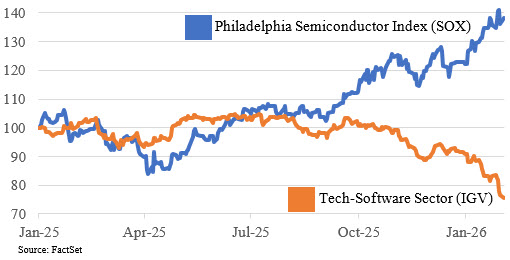
What accounts for this dramatic divergence? In the case of semiconductor and related companies, they are seeing demand for their products accelerate now. The need for chips to power data centers, or memory and storage to facilitate the growth of large language models (LLMs) is occurring today and is clearly visible to investors. On the other hand, software companies will see the benefits of AI later. That difference, the ‘we get it now’ versus ‘we will get it up the road’, has money flowing into semiconductor and related companies and out of software.
Software Faces Questions in an AI-Driven Future
In addition, there are some concerns on the part of investors over what the software world will look like as AI spreads across businesses. Will new, pure play AI companies take markets away from the software incumbents? Will vibe coding, using AI to generate software code, mean companies will use less off the shelf products and produce programs in-house? Will AI make using software easier for customers and reduce the number of software engineers, or seats they need purchase? These and other questions are weighing on many established software companies. How this ultimately plays out remains uncertain, but we will continue to track relevant changes in the AI landscape and act accordingly in the best interests of our clients.
Argent Capital is 100% employee-owned and we thank you for your business and your interest. In addition, if you like our market letters and videos, we hope you will share them with friends. For information on our five successful equity strategies–Large Cap U.S., Dividend Select, Mid Cap U.S, Small Cap U.S. and SMID Cap U.S., please contact [email protected].
Sincerely,
Ken Crawford
Portfolio Manager, Emeritus
PDF Version: Market Overview January 2026
